
PLATFORM / SCOPE

Scope is where the engagement, and the revenue, begins.

Client intake, scoping questionnaire, SoW, proposal, signature, and pipeline: tracked end to end, in one place. Every other pentest platform starts at the finding. Cairn starts at the deal.

platform.cairnsecurity.com/scope
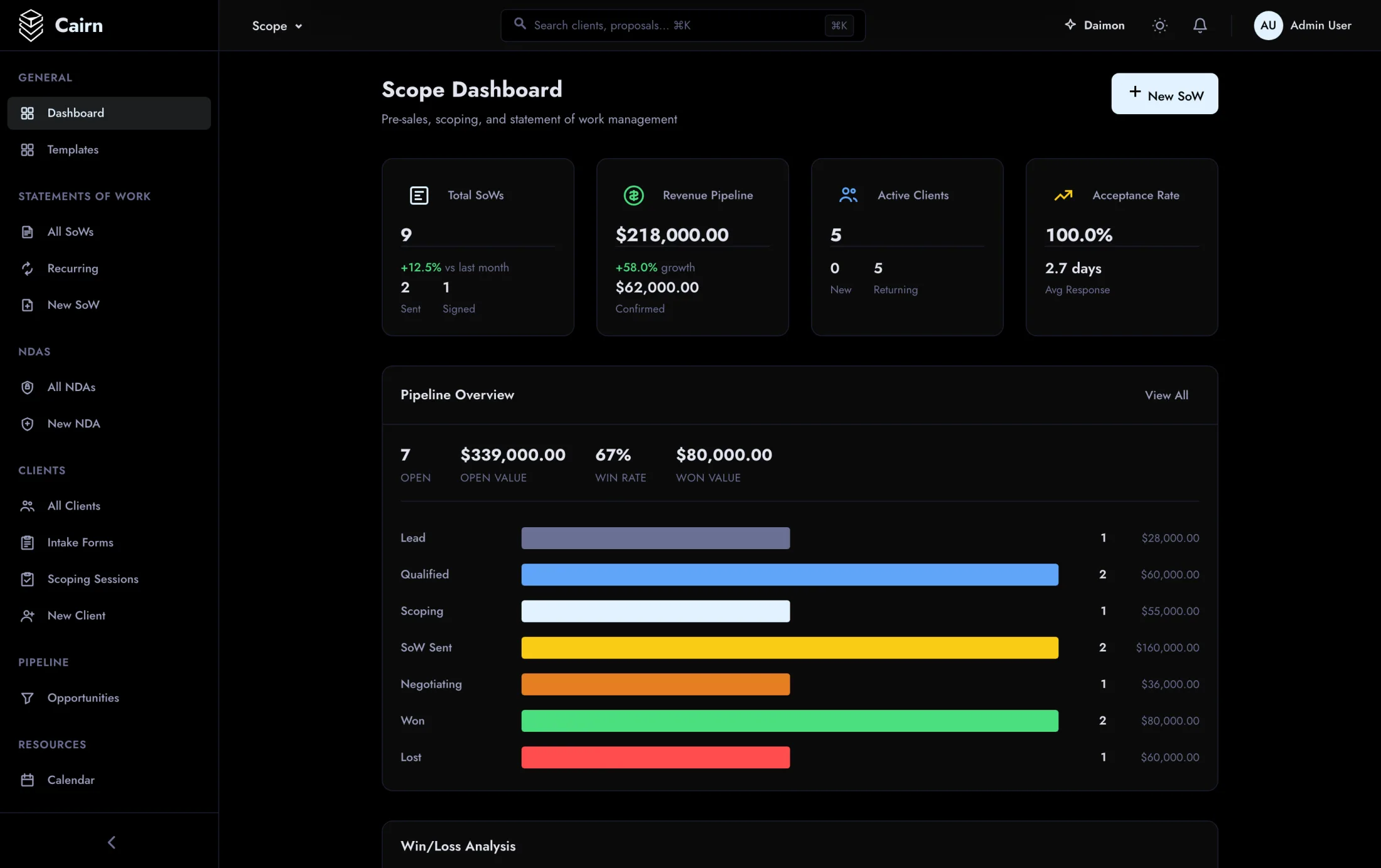
Scope dashboard with revenue pipeline and stage forecast
What Scope does

The whole front half of the engagement, in one tool.

Most reporting platforms assume the deal is already won and the scope is already set. Scope owns everything before that: turning an inbound RFP into a qualified opportunity, a scoping questionnaire into a costed SoW, and a signature into a project that Report and the Client Portal pick up without anything typed twice.

  • Clients, contacts, and full engagement history
  • Opportunity pipeline: LEAD → QUALIFIED → SCOPING → WON/LOST
  • Statement-of-Work engine with a 12-stage review-and-sign lifecycle
  • Magic-link client view, accept, reject, and e-signature (DocuSign / HelloSign)
  • Per-org service catalog and five pricing models (day-rate, fixed, T&M, retainer, call-off)
  • NDA lifecycle that gates the SoW until it is signed
  • Handoff checklists with critical-item gating before delivery
Why it’s different

Pre-sales tooling no pentest platform ships.

We checked. PlexTrac, PentestPad, Cyver, AttackForge, Dradis, none of them do proposals, SoWs, pipeline forecasting, or CRM. This is the part of the job every other tool leaves to your spreadsheets.

Pipeline forecasting

Revenue you can forecast, not guess.

Scope reconstructs the win rate of every pipeline stage from your own closed-deal history and shows your open pipeline against it, alongside trailing monthly revenue from closed deals. Grounded in your activity, not a spreadsheet guess.

  • Per-stage win rates from activity history
  • Open pipeline by stage
  • Trailing monthly revenue
Questionnaire → SoW

The intake writes the SoW.

A structured scoping questionnaire maps answers straight onto SoW fields (scope, targets, methodology, assumptions, executive summary) and estimates effort from percentile stats over your past signed engagements. Clients never see the effort weights.

  • Answer-to-field mapping
  • Historical effort estimation
  • Public client-safe form
Recurring templates

Renew a repeat engagement in one click.

Snapshot a signed SoW into a reusable template and renew it into a fresh opportunity and draft. A field-level delta view shows exactly what changed since last time (added, removed, modified), so annual retests take minutes, not a rewrite.

  • Full-SoW snapshots
  • One-click renewal
  • Field-level delta diff
Opportunity CRM

A sales pipeline built for the work.

Track opportunities with enforced stage transitions, win/loss analysis with competitor tracking, and bidirectional sync to Salesforce, HubSpot, Pipedrive, ConnectWise, and Monday, so Scope fits the CRM you already run instead of replacing it.

  • Win/loss + competitor tracking
  • Bidirectional CRM sync
  • Enforced stage RBAC
SoW lifecycle

Every SoW moves through a real state machine.

Not a status dropdown, a permissioned pipeline. Fields lock as the SoW advances, client actions (viewed, accepted) are system-driven, and each transition is gated by role.

  1. 01Scoping
  2. 02Pricing
  3. 03Tech review
  4. 04Ops review
  5. 05Sent
  6. 06Signing
  7. 07Accepted

See Scope turn a questionnaire into a costed SoW.

Walk the deal from intake to signed SoW in the product tour, or book a live session and we’ll drive it with your team.

FAQ

Questions we get about Scope.

Does Scope replace my CRM?

It can, or it can sit alongside one. Scope has its own opportunity pipeline and win/loss analysis, but it also syncs bidirectionally with Salesforce, HubSpot, Pipedrive, ConnectWise, and Monday, so you keep the system your team already lives in.

How does pricing work for a variable-scope engagement?

Five pricing models ship in the box: day-rate (the default, computed from per-assessment days and your configured rates), fixed price, time-and-materials, retainer, and call-off / day-bank framework contracts with drawdown tracking.

Can clients review and sign without a login?

Yes. SoWs go out as single-use magic links with separate view and sign purposes. Clients view, accept, reject, or e-sign (via DocuSign, HelloSign, or the built-in signer). No account required, and everything is logged.

What happens for a repeat client every year?

Save the signed SoW as a recurring template and renew it. Scope spins up a new opportunity and draft SoW from the snapshot and shows a field-level delta of everything that changed, so an annual retest is a review, not a rewrite.